
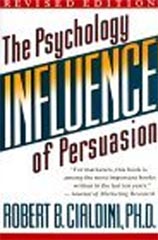
This article is the third in a series about Robert Cialdini’s book Influence: The Psychology of Persuasion
Reciprocation
According to Cialdini we are massively socialized to feel uncomfortable if someone has given us a gift or done us a favor that we have not returned. This feeling of indebtedness generally originates from one of three sources: favors, gifts, or concessions.
Apparently when someone does us a favor – even when it’s not something we wanted – the world doesn’t feel right to us until and unless we reciprocate in some way. It doesn’t seem to matter if the favor is invited or uninvited – it still feels like a debt.
Gifts can be even more problematic in terms of feeling like we need to give something back. They are used by marketers and fundraisers to stimulate our reciprocation response in all kinds of ways – from giving us free samples in grocery stores to including gift address labels with fundraising requests.
This chapter about reciprocation finally explained to me some of the baffling behavior I see humans engaging in around Christmas shopping – flocking by the millions to malls to obey the directive to exchange material objects with everyone they know. We see advertisers working overtime to exploit the reciprocation principle that time of year – missing no opportunity to remind people about the discomfort they will feel if someone gets them a gift they have not reciprocated. The winter holidays are a particularly rich season to observe this and other psychological hooks advertisers use to manipulate us. I wrote about this phenomenon in That perfect gift – part 1 and part 2.
Concessions are a particularly powerful way to invoke the power of reciprocation because they usually also involve the principle of perceptual contrast. For example, if someone asks you for a large donation then “settles” for a much smaller one, the smaller figure may not sound like that much money when compared with the larger sum you had been considering a moment before. In addition, you may feel as if that person has made a concession by accepting a lower number and that you “owe” them one as well – i.e. making the small donation they wanted from you all along!
Watch for all three of these variants of the reciprocation principle as you deal with salespeople. I notice them everywhere now that I’m aware of them, and feel the powerful pull of my instinct to respond by automatically giving back. Of course, in some cases giving back is appropriate. What we’re really interested in here is the power of these techniques to elicit a response from us, and to explore whether any of them might be useful in helping us to accomplish goals we have set for ourselves.
Personal marketing ideas
Perhaps you’ve planned to reward yourself with a gift or favor after finishing a big goal. Instead of waiting until the goal is complete, consider buying the gift ahead of time. Then stimulate the discomfort of a reciprocation debt by taking a picture of yourself with the gift. Display that picture to yourself frequently in one of several ways I have already suggested, such as putting it on your refrigerator, on your computer desktop background or in your Hipster PDA. You could also add text or images associating it with the goal you want to get done. This is kind of a dirty technique, because it’s supposed to make you feel guilty until you follow through. If it works, do you care?
I already wrote about another technique that can be used to stimulate reciprocation in the previous article about perceptual contrast. In that method, I suggested advertising for something harder to accomplish than your actual goal for a couple of weeks so that when you start running ads for your real goal it will look easy by comparision.
By asking for something really large and hard from yourself and then settling for something smaller and easier, you’ll benefit both from the contrast between the two – the second thing will seem even easier to do than it would have if you’d started with that goal in the first place – and also from the debt incurred when you make a concession. You will have done yourself a huge favor by backing off of your initial ambitious goal. According to the principle of reciprocal concessions, you should now feel obligated to go ahead and do that smaller, easier thing.
If you can think of a way to remind yourself about this favor you’ve done yourself, you’ll have your ad. Techniques that are used in infomercials come to mind. The old way of doing the task always looks ridiculously clumsy and difficult in an infomercial, while the product they’re selling makes accomplishing the same job look happy and effortless. Both states are exaggerated. Perhaps you could use contrasting imagery in a similar way to compare your two goals.
So for example if you are comparing two exercise programs, you could photograph yourself doing the hard program, looking sweaty, messy, sore and miserable. Then photograph yourself looking happy and comfortable, easily doing the exercise you want to do, and put both of those photos into a gadget or screensaver photo rotation.
Other articles in the psychology of persuasion series
- The psychology of persuasion – because
- The psychology of persuasion – perceptual contrast
- The psychology of persuasion – reciprocation (you are here)
- The psychology of persuasion – consistency
- The psychology of persuasion – social proof
- The psychology of persuasion – liking
- The psychology of persuasion – authority
- The psychology of persuasion – scarcity
Leave a Reply